
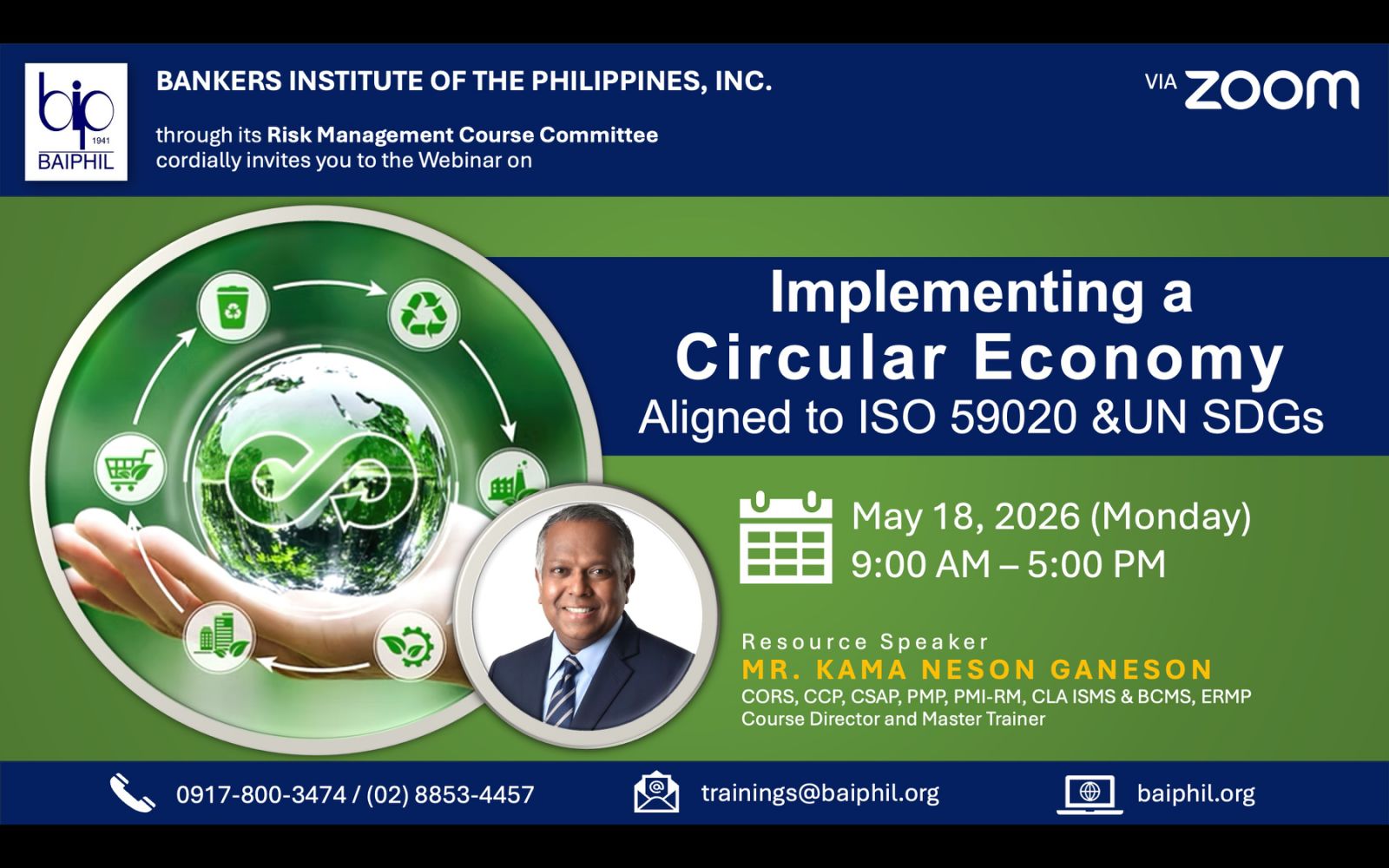
Description
PROGRAM OUTLINE
A circular economy training typically aims to shift mindsets and equip participants with the knowledge and tools to reduce waste, maximize resource efficiency, and rethink traditional “take-make-dispose” models, covering primary objectives such as raising awareness on the principles and urgency of moving away from linear economic models, as well as highlighting global environmental challenges and opportunities for sustainable development.
We can also build knowledge and understanding of the core concepts of reuse, repair, refurbish, recycle, and regenerative design, and illustrate how circular systems work in practice across industries like fashion, food, technology, and construction.
Help participants align circular economy initiatives with national sustainability goals and regulations. Enable organizations to develop roadmaps and action plans for circular transformation.
Inspire participants to rethink consumer habits, production methods, and corporate strategies, and foster a culture of innovation and collaboration across supply chains.
Lastly, the class will encourage a holistic understanding of interconnected systems—economy, environment, and society.
COURSE DURATION
1 DAY
LEARNING OBJECTIVES
At the end of the training, participants are expected to:
- Understand and articulate the principles and importance of the circular economy
- Identify opportunities for circularity within operations, products, and policies
- Develop strategies and implement circular business models
- Navigate regulatory environments and measure circular performance
- Communicate circular economy concepts effectively to stakeholders
TARGET AUDIENCE
Sustainability professionals, supply chain managers, product designers, policymakers, consultants, and business leaders interested in circular strategies.
This training applies to all types of organizations, regardless of their size, products, or services. It is also intended for all organizations in the public and private sectors.
PROGRAM STRUCTURE AND OUTLINE
The Program is delivered through a combination of instructor-led lectures, case studies, and exercises on the practical application of the concepts covered in the training. The topics presented below define the areas of focus under the program:
Module 1:
- Introduction to the ISO 59000 Series and Circular Economy Frameworks
-
- Understanding the ISO 59000 Series:
Overview of the ISO 59000 standards, including ISO 59001, ISO 59010, and ISO 59020.
-
- Explanation of their significance in establishing a global framework for circular economy practices.
- Principles of the Circular Economy:
- Introduction to circular economy concepts such as regenerative design, closing material loops, and life cycle thinking, based on ISO guidelines.
- Standardization for a Circular Economy:
-
- How the ISO 59000 series contributes to uniform practices and benchmarks for circularity across industries.
Module 2:
- Circularity Assessment and Metrics (ISO 59020) Measuring Circularity:
-
- Explanation of ISO 59020 guidelines for assessing circularity, including material efficiency, recycling rates, and product life cycle analysis.
- Circular Economy Indicators:
-
- Key indicators and metrics for evaluating the circular performance of products, processes, and organizations.
- Data Collection and Reporting:
-
- Guidelines for collecting data on circularity, setting benchmarks, and reporting progress according to ISO standards.
Module 3:
- Circular Design and Innovation (ISO 59010) Designing for Circularity:
-
- Principles of circular product design based on ISO 59010, such as modularity, durability, and ease of disassembly.
- Life Cycle Thinking in Design:
-
- Incorporating Life Cycle Assessment (LCA) to minimize environmental impacts and enhance product circularity
Resource Speaker:
MR. KAMA NESON GANESON
CORS, CCP, CSAP, PMP, PMI-RM, CLA ISMS & BCMS, ERMP
Course Director and Master Trainer
Schedule:
May 18, 2026 (Monday) 9:00 AM – 5:00 PM
Training Fee per Participant:
Member Institution – Php 3,920.00
Non-Member Institution – Php 5,040.00
*VAT inclusive